Two corners of an isosceles triangle are at #(8 ,2 )# and #(4 ,3 )#. If the triangle's area is #9 #, what are the lengths of the triangle's sides?
↳Redirected from
"How do I change #int_0^1int_0^sqrt(1-x^2)int_sqrt(x^2+y^2)^sqrt(2-x^2-y^2)xydzdydx# to cylindrical or spherical coordinates?"
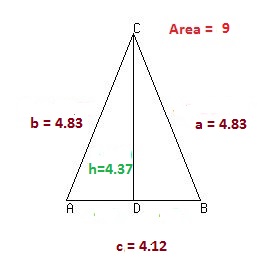
#color(indigo)("Isosceles triangle's sides are " 4.12, 4.83, 4.83#

#A(8,2), B(4,3), A_t = 9#
#c = sqrt(8-4)^2 + (3-2)^2) = 4.12#
#h = (2 * A_t) / c = (2 * 9) / 4.12 = 4.37#
#a = b = sqrt((4.12/2)^2 + 4.37^2) = 4.83#
Base #\sqrt{17}# and common side #sqrt{1585/68}.#
They're vertices, not corners. Why do we have the same bad wording of the question from all around the world?
Archimedes' Theorem says if #A,B and C# are the squared sides of a triangle of area #S#, then
# 16S^2 = 4AB-(C-A-B)^2#
For an isosceles triangle, # A=B.#
#16S^2 = 4A^2-(C-2A)^2 = 4AC-C^2#
We're not sure if the given side is #A# (the duplicated side) or #C# (the base). Let's work it out both ways.
#C = (8-4)^2 + (2-3)^2 = 17#
# 16(9)^2 = 4A(17) - 17^2 #
# A = 1585/68#
If we started with #A=17# then
# 16(9)^2 = 4(17)C - C^2 #
# C^2 - 68 C + 1296 = 0 #
No real solutions for that one.
We conclude we have base #\sqrt{17}# and common side #sqrt{1585/68}.#